
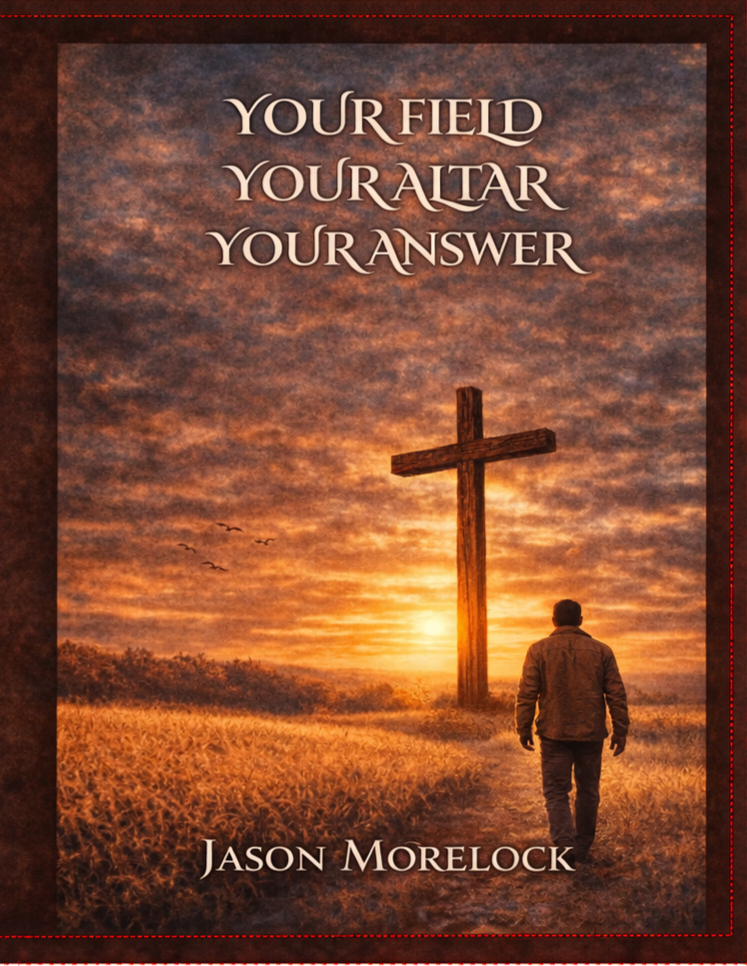
Your Field
Your Altar
Your Answer
Chapter 6 – Holding On for a Blessing
Scripture (NASB):
“Then he said, ‘Let me go, for the dawn is breaking.’ But he said, ‘I will not let you go unless you bless me.’” — Genesis 32:26
There comes a point in every believer’s life when running out of strength is no longer something to be avoided.
It becomes necessary.
For years, I lived with a quiet awareness that God had intervened in my life more than once. I knew He was real. I knew His authority was absolute. What I did not yet know was how to fully surrender control. I wanted God’s protection without His correction. I wanted His mercy without His mastery.
That tension eventually demanded resolution.
The story of Jacob wrestling with God had always unsettled me. Jacob did not approach God from a place of confidence or clarity. He approached Him exhausted, fearful, and desperate. He was running from consequences he could no longer outrun, and he encountered God in the darkness—not with answers, but with resistance.
That resonated with me more than I wanted it to.
Jacob wrestled all night, not because he was strong, but because he was unwilling to let go. His grip was not forceful; it was dependent. He held on because he knew that letting go would mean returning to the same life, the same fear, the same uncertainty.
I recognized myself in that struggle.
There were nights when prayer felt less like reverence and more like wrestling. I wasn’t arguing with God. I wasn’t demanding anything from Him. I was simply refusing to walk away unchanged. I had reached a place where I knew that pretending was no longer an option.
I could not go back.
What Jacob wanted was not escape.
He wanted assurance.
God did not rebuke Jacob for wrestling. He allowed it. In fact, Scripture shows that God initiated the encounter. The struggle was not evidence of rebellion—it was evidence of engagement. Jacob was no longer running. He was facing God directly, even if he didn’t yet understand what that meant.
That distinction changed the way I understood prayer.
For a long time, I believed faithful prayer meant calm confidence, certainty, and peace. Wrestling felt like failure. Doubt felt like disobedience. Questions felt dangerous. But the Word of God paints a different picture. Many of the people God used most profoundly encountered Him in moments of confusion, fear, and desperation.
Jacob’s breakthrough came when his strength failed.
God touched his hip, crippling him, not to punish him but to transform him. From that moment forward, Jacob could no longer walk the same way he had before. His limp became a reminder that dependence had replaced self-reliance.
I began to see that God was doing something similar in me.
There were areas of my life where I had learned to cope instead of trust. I had learned how to function without surrendering fully. God did not tear those structures down violently. He simply applied pressure until they no longer held.
Wrestling with God stripped away illusions. It exposed the places where I had relied on habit instead of faith, effort instead of obedience. And though it was uncomfortable, it was necessary.
Jacob asked for a blessing, but God gave him something greater.
He gave him a new name.
Names in Scripture are never incidental. They speak to identity, calling, and destiny. Jacob’s name meant “deceiver,” a reflection of the way he had lived his life—grasping, striving, manipulating outcomes through his own effort. But after the wrestling, God called him Israel, “one who strives with God.”
The change did not erase Jacob’s past. It redefined his future.
That distinction mattered to me. I realized that God was not asking me to deny where I had been or pretend that my struggles had not shaped me. He was asking me to stop letting those things define me. Wrestling had not disqualified Jacob. It had marked him.
The limp Jacob carried was not a symbol of weakness. It was a sign of encounter.
In the same way, the internal wrestling I experienced did not leave me defeated. It left me honest. I no longer needed to maintain appearances or justify my shortcomings. God was not impressed by performance. He was responding to surrender.
Holding on for a blessing was never about demanding something from God.
It was about refusing to let go until I was changed.
That realization reshaped my faith. Prayer became less about outcomes and more about alignment. Obedience became less about compliance and more about trust. And identity became less about who I had been and more about who God was calling me to become.
I could walk forward with a limp.
But I could not walk backward into denial.
And for the first time, that felt like freedom.
⭐ Readers Say
“I couldn’t put it down.”
Again and again, readers say they finished the book in one sitting. Some read it twice. Others say their spouse read it straight through. The pacing, the clarity, and the sense of God’s presence make it a book people don’t want to step away from.
“God met me in these pages.”
Readers describe moments where memories surfaced, tears came, and the Holy Spirit highlighted parts of their own story. Many say the book helped them recognize God’s presence in seasons they once misunderstood — especially in pain, failure, or silence.
“This book helped me hear God more clearly.”
People say the book gave them language for what God was already doing in their lives. It helped them discern His voice, understand His timing, and see His hand in ordinary moments they once overlooked.
“It’s for anyone — no matter where you are with Christ.”
New believers, lifelong Christians, and people wrestling with calling all say the same thing: the book speaks directly to them. It’s accessible, relatable, and grounded in Scripture without feeling heavy or academic.
“It’s full of spiritual insight.”
Readers highlight the depth of biblical understanding, the practical wisdom, and the lived experience behind the writing. They describe it as rich with “Holy Spirit insights,” “nuggets of wisdom,” and truth that stays with them long after reading.
“This book gave me hope.”
Many say it reminded them of God’s grace, His pursuit, and His faithfulness — especially in seasons when they felt unseen or unheard. It helped them surrender, trust, and take the next step with confidence.